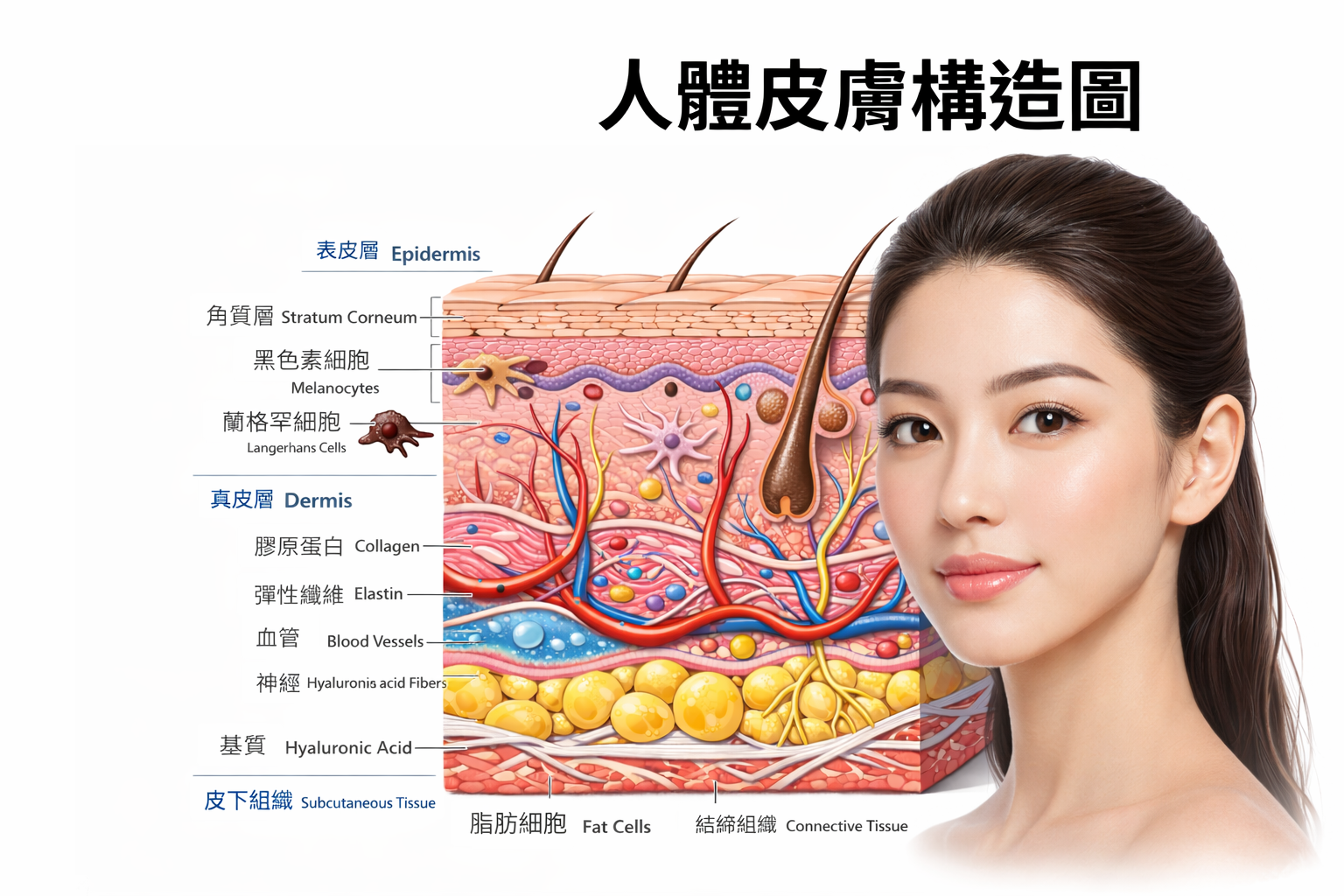
 1. Why Start Skincare from Skin Structure?
Many common skin concerns—such as dryness, oiliness, sensitivity, and aging—are fundamentally related to the skin’s structure and function.
Skin is not a flat surface, but a multi-layered, dynamic organ system, composed of three primary layers:
- Epidermis
- Dermis
- Subcutaneous Tissue
👉 In simple terms:
Different layers → Require different skincare strategies
2. The Three Main Skin Layers (Outer to Inner)
① Epidermis: The First Line of Defense (Foundation of Skincare)
Key Structure
The epidermis is the outermost layer, mainly composed of keratinocytes, along with melanocytes and immune cells.
👉 The most critical part is:
Stratum Corneum
- Made of dead skin cells
- Forms a “brick-and-mortar” structure (cells + lipids)
- Responsible for barrier protection and moisture retention
Function
✔ Prevents water loss
✔ Protects against external aggressors (UV, pollution)
✔ Maintains skin stability
Skincare Logic (Most Important)
👉 About 90% of skincare happens here
✔ Gentle cleansing (to avoid barrier damage)
✔ Hydration (toner / essence)
✔ Moisture sealing (lotion / cream)
👉 Core concept:
Healthy barrier = Stable skin condition
② Dermis: The Key to Elasticity and AgingKey Structure
Located beneath the epidermis, the dermis is the thickest skin layer.
Composed of:
- Collagen
- Elastin
- Extracellular matrix (e.g., Hyaluronic Acid)
Divided into:
- Papillary layer
- Reticular layer
Function
✔ Provides structural support and elasticity
✔ Supplies nutrients (via blood vessels)
✔ Enables sensory perception (via nerves)
Skincare Logic
👉 The dermis is the “core of anti-aging”
However:
❗ Most topical skincare cannot directly reach the dermis
Therefore, the strategy is:
✔ Indirect stimulation (e.g., gentle exfoliation, renewal)
✔ Maintain epidermal health to reduce degradation
✔ Use functional ingredients (peptides, niacinamide, etc.)
👉 Core concept:
Anti-aging is about slowing loss, not reversing structure
③ Subcutaneous Tissue: Structural Support & Facial Volume
Key Structure
Mainly composed of fat and connective tissue
Function
✔ Shock absorption
✔ Energy storage
✔ Maintains facial fullness
Skincare Logic
👉 Topical skincare has minimal impact on this layer
Therefore:
✔ Lifestyle management (diet, sleep)
✔ Aesthetic treatments (fillers, lifting)
👉 Core concept:
Facial aging is largely influenced by structural volume loss
3. Skincare Routine Based on Skin Structure
Step 1|Cleansing (Stratum Corneum)
✔ Removes dirt and excess oil
✔ Maintains sebum balance
👉 Over-cleansing = Barrier damage
Step 2|Hydration (Water Content)
✔ Improves softness
✔ Reduces dryness
Step 3|Moisturizing (Lipid Barrier)
✔ Prevents water evaporation
✔ Stabilizes skin environment
Step 4|Targeted Treatments
(Act on epidermis → indirectly influence dermis)
✔ Brightening (even skin tone)
✔ Repairing (strengthen skin condition)
✔ Anti-aging (slow structural decline)
4. Common Skincare Misconceptions
❌ Myth 1: More hydration is always better
👉 Truth:
Hydration without sealing leads to faster moisture loss
❌ Myth 2: Higher concentration = better results
👉 Truth:
Skin has absorption limits (mainly epidermal level)
❌ Myth 3: Anti-aging must reach the dermis
👉 Truth:
Most daily skincare works primarily on the epidermis
5. The True Skincare Philosophy
👉 One simple statement:
Effective skincare works with skin biology, not against it
✔ Epidermis → Hydration & barrier care
✔ Dermis → Slow down degradation
✔ Subcutaneous → Lifestyle & aesthetic support


